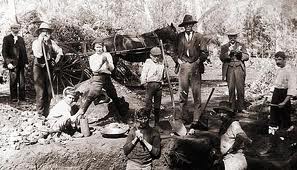
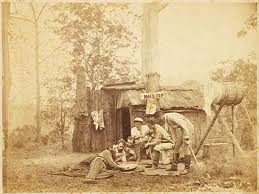
The Australian Gold Rush played an important part in Australia's History.
In Just 4 months, Ophir was filled with over 1000 prospectors after the discovery made by Edward Hargraves. Everyone was rushing to Ophir in the hope of finding gold. There were so many people at the Goldfields that the government started to had out 'Commissioners of Land' to allocate the diggings and accumulated license fees for every 'claim'. Hargraves would have never realised how important his discovery was. New South Wales was home to 26.4 tonnes of gold in 1852. but this was nothing compared to the amount Victoria had after they joined the Gold Rush. But Victorian authorities were worried that its population would join the Gold Rush in Ophir, thus they proposed a reward of £200 for any gold found within 200 miles of Melbourne. Six months after the discovery of gold in New South Wales, Gold was found in Ballarat, then shortly after at Bendigo Creek. |
||||||||||
|
|
|||||||||